
HESTIA Sandpit Debrief- A dive into ‘healthy homes’
What happens when engineers, researchers, companies, charities, housing associations and community groups get in a room together? A HESTIA sandpit debrief.
May 2026, Emma attended the Home Environment Solutions through Technology and Innovation for All (HESTIA) event in York.
The event was a sandpit which is an intense, facilitated workshop where diverse participants throw out ideas, challenge assumptions, and build new research projects together. This one focused on three big things:
The impacts of climate change on housing – and how homes can be ‘future-proofed’
How existing technologies in homes might help meet low-carbon goals and promote human health
Co‑producing healthy homes with communities affected by poor quality housing
The HESTIA logo
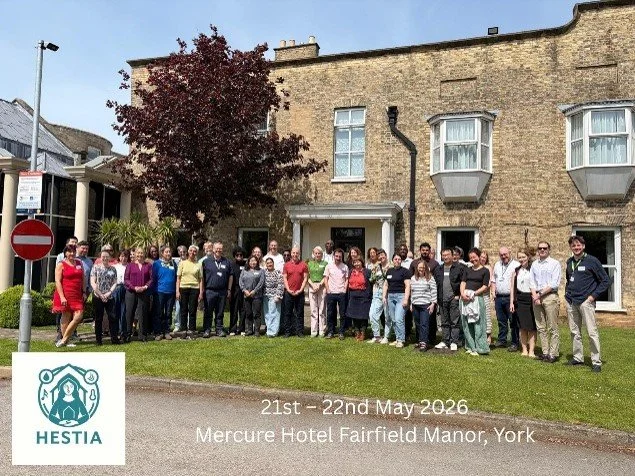
Attendees of the event stood outside a building
Emma reflects on the event:
The big question: what does an ecological healthy home look like?
It was great to meet so many people who genuinely care about the environment we live in. Everyone had their own idea of an ecological healthy home shaped by their perspective: technological, community‑based, industry‑led, and most importantly location.
We talked about a lack of environmental/health education, building physics knowledge, retrofit, fuel poverty, resilience, and the dreaded ‘behaviour change’ of people. There was a mixed bag of interesting conversations around the tables, alongside the collaboration of great ideas, product developments, and research projects.
We were all in competition with each other, all trying to get the funding that was available. That’s the nature of sandpits. But it also made me wonder: who gets left out when we race for resources?
Here’s what stood out and why it matters to community research.
There is a need to gauge what people who live in and use proposed technologies think an eco-healthy home looks like, and how it will impact them.
Are people aware that their own home might not be considered a healthy home and why that might be the case?
What does an eco-healthy home look like in different areas (countryside, inner-city, coastal communites)?
The HESTIA sandpit didn’t solve the problem of healthy homes. But it clarified the question: we can’t design solutions for communities without communities in the room.
Before anyone designs a ‘healthy home’ for someone, we need to know:
Where are people at right now with environment – health knowledge?
What are their current homes actually like?
What are their main issues, and what’s their capacity for change?
It's not about building new behaviour it's about clearing the path to what's already possible.
During the event it was a genuine pleasure to talk to people about what Boingboing Foundation does – our activism for resilience. Sharing how resilience is often misunderstood. It’s not just about ‘bouncing back’ as an individual. Resilience is ecological.
That’s why our co‑production research method working with community members as co‑researchers matters so much. Behaviour isn’t wholly individual. Someone struggling to sleep might need cognitive behavioural therapy. Or they might just need sound insulation. Both are valid, but they’re very different interventions.
If you’re working at the intersection of housing, climate, health or community resilience we’d love to hear from you.